What Should Be Included on a Healthcare ID Badge? A Canada-Focused Guide
Healthcare settings move quickly. People change rooms, roles, shifts, departments, and priorities all day long. In that environment, an ID badge is not just a piece of plastic clipped to scrubs or a lanyard. It is a fast visual cue that helps staff, patients, visitors, contractors, and security teams understand who someone is and what role they play.
A strong healthcare ID badge should be easy to read, easy to verify, privacy-conscious, and durable enough for daily use. Most importantly, it should help people make quick decisions without forcing them to stop and decode a crowded layout.
What are the essentials?
There are several essential components that ever healthcare ID badge should contain:
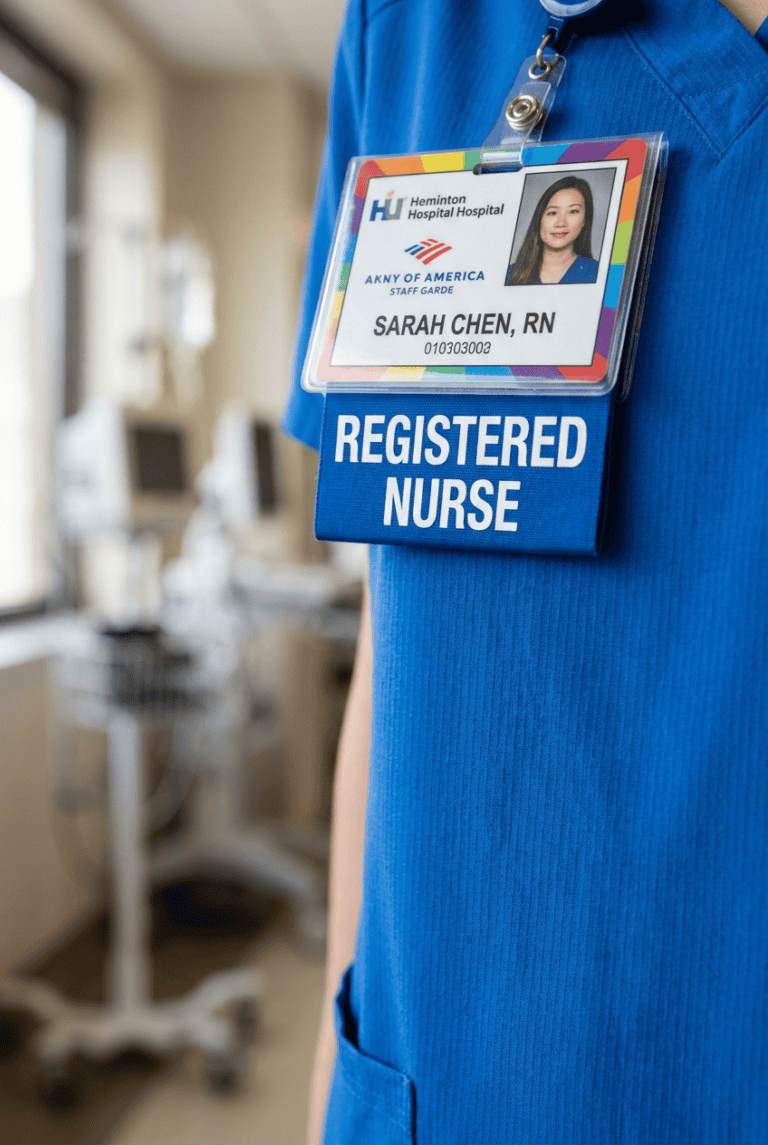
Current Photo
The photo should be current, consistent, and large enough to support quick recognition. Avoid using photos that are too small, too dark, or cropped inconsistently. A healthcare badge may be viewed in hallways, reception areas, patient rooms, and secure spaces. The photo needs to work in the real world, not just on a design proof.
Readable Name
The name should be readable, but organizations should decide whether first name, full name, or preferred display name makes sense for their environment. Some healthcare teams may prefer full names for accountability, while others may use role-based identification or first names depending on privacy, safety, and internal policy.
Role Clarity
Role clarity is one of the most important elements in healthcare badge design. A patient, visitor, or new staff member should be able to quickly distinguish between a nurse, physician, student, security team member, volunteer, contractor, or visitor. Large role bands can help.
Colour coding can also help, but it should never be the only indicator. Use text plus colour so the badge remains understandable for everyone.
QR Codes
A QR code or barcode can make the badge more useful without cluttering the front. For example, a QR code can link to a secure staff verification page, an internal profile, a training confirmation, or a check-in workflow. A barcode can support timekeeping, access systems, inventory, equipment sign-out, or internal staff records.
The key is to avoid embedding sensitive information directly in the code. The code should point to a secure system rather than expose private information.
Durability
Durability also matters. Healthcare badges may be worn daily, cleaned frequently, clipped to uniforms, swiped, scanned, and handled by busy staff. Design choices should account for wear areas, code placement, contrast, and protective finishing. A QR code that gets scratched or a barcode placed near a punched slot can quickly become a workflow problem.
Expiration Dates
Healthcare badges may also need expiry dates or validity indicators for students, temporary staff, contractors, vendors, and visitors. Temporary badges should look temporary. A small expiry date hidden in the corner is not very useful. If the person’s access is time-limited, the badge should make that clear.
What should your ID badge not contain?
What should not be printed on a healthcare ID badge? Avoid unnecessary personal information, sensitive medical details, private internal notes, long policy text, or identifiers that could create risk if the badge is lost. In Canada, privacy-first thinking matters.
A simple rule is this: if the information does not need to be visible at a glance, consider moving it behind a secure QR code, a barcode lookup, or an internal system.
A Strong ID Badge Must Have
- Clear photo
- Name or approved display name
- Large role or credential label
- Organization logo or facility identifier
- QR code or barcode for secure verification or workflow use
- Expiry date for temporary users
- Site, department, or access indicator if required
- Durable material and finishing suited to daily use
The best healthcare badges are clean, role-focused, and practical. They do not try to print every possible detail. They show what needs to be visible and move deeper information into secure systems.
A healthcare ID badge should help the right people move confidently, help staff identify who belongs where, and support a safer, clearer workplace. When designed well, it becomes a small but important part of the operational flow.
Small, But Mighty
A healthcare ID badge may be small, but it carries a lot of responsibility.
It helps patients understand who is caring for them. It helps staff quickly identify roles, departments, visitors, contractors, and temporary team members. It supports safer workflows, clearer communication, and faster verification — especially when QR codes or barcodes are integrated into the design.
Yet, the most effective healthcare badges are not overloaded with information. They are clean, intentional, and built around what people need to know at a glance: who the person is, what role they have, and whether they belong in that space.
If your current badges are hard to read, inconsistent, outdated, worn down, or missing scannable functionality, it may be time to rethink the design. A better badge system can improve professionalism, reduce confusion, and support your team’s day-to-day workflow without adding unnecessary complexity.
Need healthcare ID badges that are clear, durable, scannable, and designed for real workplace use?
Request a custom healthcare badge layout review, and we’ll help you identify what to keep, what to simplify, and where QR codes or barcodes can make your badges work harder, without making them look cluttered.
FAQ
Photo, name, role, organization, scannable code (if needed), and expiry date for temporary users.
Yes, if QR codes connect to secure verification or workflow systems without directly exposing sensitive information.
Table of Contents
Centralized vs. Decentralized Badge Printing for Healthcare
Centralized vs. Decentralized Badge Printing in Healthcare? Let Someone Else Handle It. Let’s be real for a second. If you’re managing a hospital department, a
5 Must-Have Features for Trades ID Badges
5 Must-Have Features for Trades ID Badges That Actually Work on Site Forget flimsy paper badges or faded clips. On a busy job site, your
Centralized vs. Decentralized Badge Printing
Centralized vs. Decentralized Badge Printing: Which One Actually Fits Your Team? Let’s be honest: the last thing you want is an ID badge system that
QR Code Badges: Your Pocket Digital Workstation
Stop Your ID Badge from Being Lazy: Turn It Into a Digital Workstation Let’s be real. Your employee badge has one job: get you through
Unified Healthcare IDs: A Compliance Framework
How to Manage Badge Compliance for Staff, Residents, and Visitors Without the Headache If you manage badges in a healthcare or LTC setting, you know
PVC vs. Polyester vs. Generic Plastic ID Badges
PVC vs Polyester vs. Cheap Plastic: A No-Nonsense Guide to Badges That Won’t Quit on You Let’s be real: your average employee ID badge has