More Than Just a Name Tag
In a Canadian healthcare facility—whether a high-traffic ER in Toronto or a long-term care home in rural Saskatchewan—the ID badge is a critical interface. It is the first thing a patient looks at to verify authority, the tool that unlocks secure medication dispensaries, and the visual marker of a professional team.
However, the “standard” ID badge used in corporate offices often fails in the rigorous medical environment. This guide explores the transition toward Vertical Retransfer ID Badges as the gold standard for Canadian healthcare infrastructure.
1. The Geometry of Care: Why Vertical is the Healthcare Choice
Historically, ID badges were horizontal, mimicking the shape of a credit card. While this works for wallets, it fails for practitioners.
The "Stethoscope Conflict"
Healthcare workers are constantly in motion. They lean over patients, move heavy equipment, and wear stethoscopes around their necks. A horizontal badge has a wide surface area that catches on clothing or equipment, causing it to flip over constantly. When a badge flips, the identification is lost, violating security protocols.
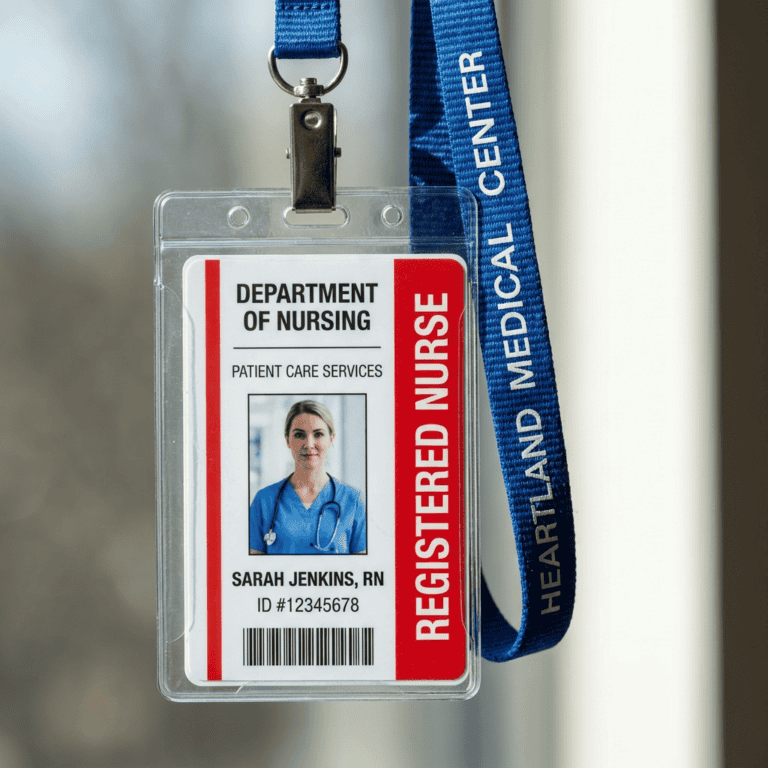
Vertical orientation solves this by narrowing the profile. It naturally hangs flat against scrubs and remains legible even when the wearer is in motion.
The Clear Visual Hierarchy
In a medical crisis, seconds matter. Vertical badges allow for a “top-down” information hierarchy:
- Top: Hospital Logo (Verification of Authority)
- Center: High-resolution Photo (Individual Verification)
- Below Photo: Full Name (Human Connection)
- Bottom: Role Designation Bar (Instant Recognition)
Once inside, the attacker can access server rooms, executive floors, or any other area the original badge holder was authorized to enter. They can plug devices into network infrastructure, access unlocked terminals, or simply observe and photograph sensitive materials. All of this happens below the radar of a digital zero-trust system.
2. Hygiene and the "Chemical Resistance" Challenge
Canadian hospitals follow strict Infection Prevention and Control (IPAC) guidelines. Every surface, including ID badges, must be able to withstand frequent disinfection with medical-grade chemicals.
The Failure of Direct-to-Card (DTC) Printing
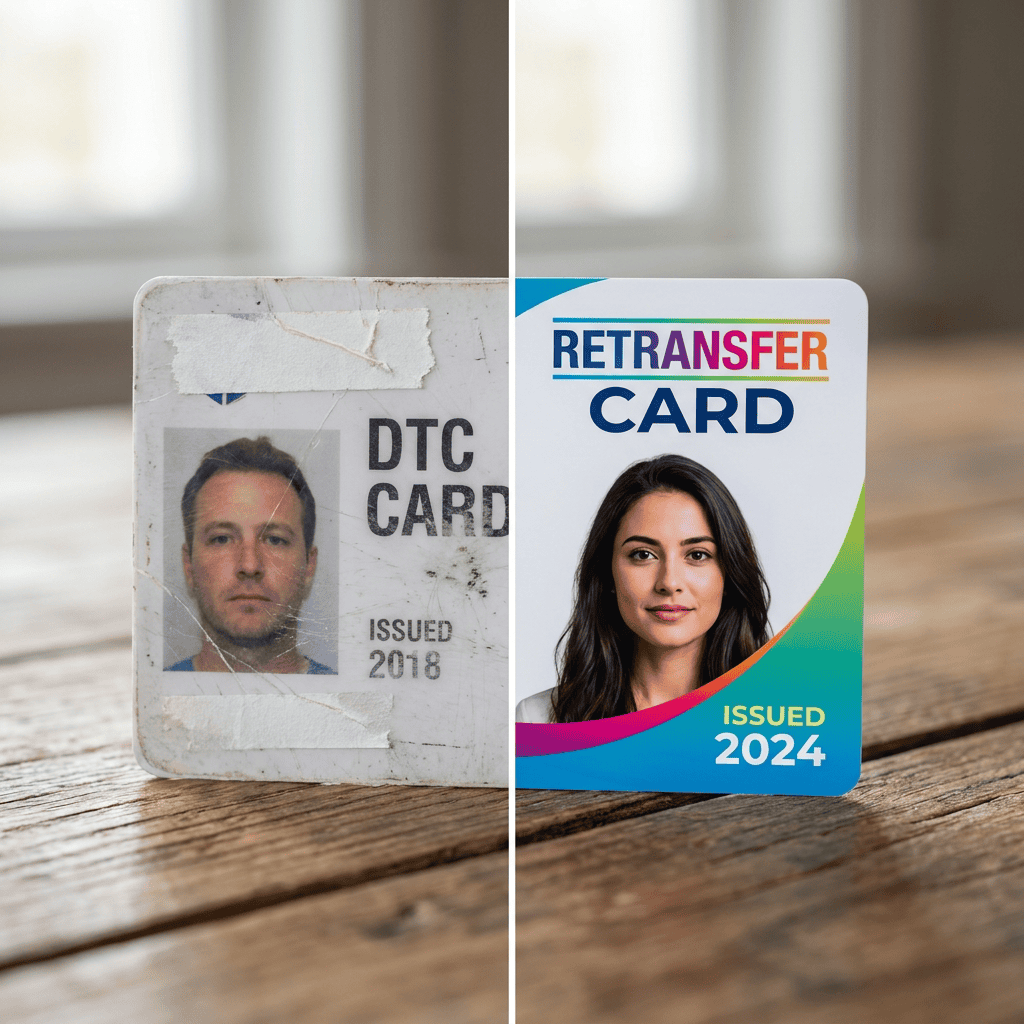
Most entry-level ID printers use DTC technology, where the printhead applies ink directly to the plastic card. If you wipe a DTC card with a CaviWipe or a high-alcohol disinfectant, the ink eventually softens, smudges, and fades. This makes the badge unreadable within months.
The Retransfer Solution
At abc identity, we exclusively recommend Retransfer Technology for healthcare. Instead of printing on the card, the image is printed onto a clear film, which is then thermally bonded to the card. The “image” is essentially sandwiched under a protective layer. This creates a badge that is:
- 100% Waterproof: Ideal for sink-side use.
- Chemical-Resistant: Stands up to bleach, alcohol, and hydrogen peroxide wipes.
- Edge-to-Edge Perfect: No white borders where bacteria can hide.
3. Patient Safety and Role Identification
Patient safety is at the heart of the CSA Z8000 (Canadian Health Care Facilities) standards. A patient should never have to ask, “Who are you?”
Colour-Coded Role Bars
We incorporate high-contrast “Role Bars” at the bottom of the vertical badge. By standardizing these across a facility—Red for Registered Nurses (RN), Blue for Physicians (MD), Green for Security—you create an environment where even a confused or distressed patient can identify the right person for help.
Large-Scale Typography
As our population ages, “Readability” is an accessibility requirement (AODA). We recommend high-contrast sans-serif fonts for the “ROLE” section, ensuring it is readable from at least 5 feet away.
4. Technical Integration: Beyond the Photo
A healthcare ID must integrate with the facility’s digital ecosystem.
Encoded Security
Most modern Canadian hospitals utilize “Smart” IDs. These include:
- Barcodes: For “Time and Attendance” or accessing hospital portals.
- QR Codes: To quickly link to internal staff training or emergency protocols.
Vertical badges provide a superior layout for these technical elements, keeping the barcode at the bottom for easy “scanning while wearing.”
5. Case Study: The Healthcare Transition
A mid-sized Ontario clinic was experiencing a 40% “Faded Card” return rate every six months. HR was overwhelmed with reprinting costs. After switching to abc identity’s Retransfer Vertical Badges, the return rate dropped to less than 1% over a 24-month period. The facility saved thousands in both physical card stock and administrative hours.
Investing in Infrastructure
Your ID badge is the frontline of your facility’s security and branding. For Canadian healthcare providers, choosing a vertical, retransfer-printed badge isn’t just a design choice: it’s a commitment to hygiene, safety, and long-term cost-efficiency.
Ready to upgrade your healthcare facility? Contact abc identity for more information.
* Case Studies illustrate potential outcomes of how we can help you with excellent results. All information is fictitious in nature and used for illustrative purposes.