5 Ways Smart ID Badges Reduce Admin Time in Manufacturing
Your floor supervisor has enough on their plate. Between managing shift changes, coordinating contractors, handling safety checks, and keeping production on track, the last thing they should be doing is chasing down a sign-in sheet.
Yet in many manufacturing facilities, manual processes for tracking who’s on the floor — and when — quietly consume hours of valuable time every week. The culprit isn’t laziness or poor planning. It’s the gap between your people and the systems designed to support them.
Smart ID badges with QR codes, barcodes, and microtext security features close that gap. Here are five concrete ways they reduce administrative burden — and what that means for your bottom line.
1. Automated Shift Entry: No More Manual Sign-Ins
Paper sign-in logs and manual clock-in processes might seem like a small inconvenience, but the admin cost adds up fast. Someone has to distribute the sheets, collect them, decipher the handwriting, and enter the data somewhere useful. Then do it all again tomorrow.
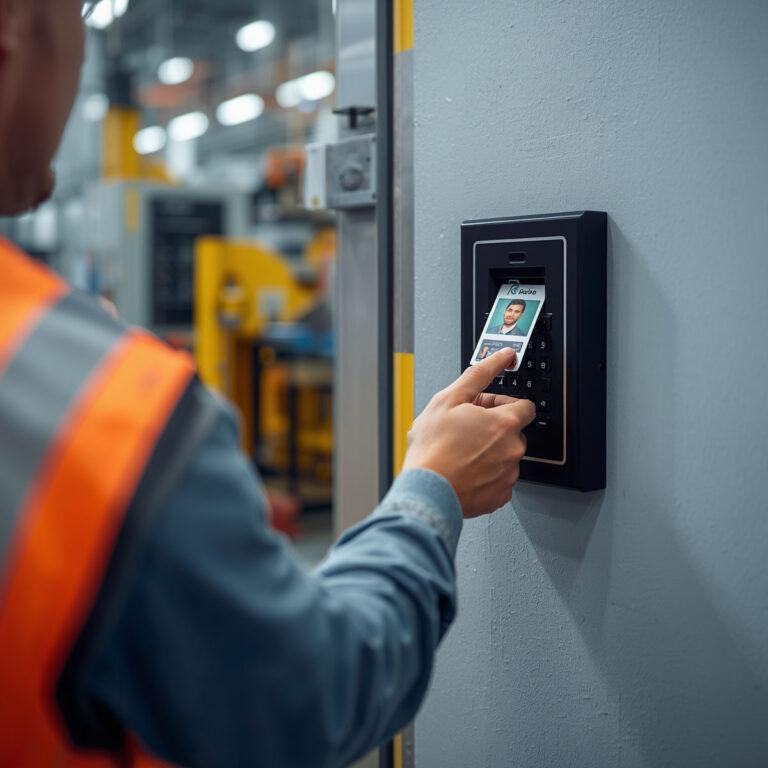
A barcode or QR-coded ID badge turns shift entry into a single scan. Employees badge in at the start of their shift, and the data flows directly into whatever workforce management or time-tracking tool you already use. No manual entry. No transcription errors. No missing records.
The Result: Supervisors start their shift managing people — not paper.
REAL WORLD IMPACT
Manufacturing facilities that move from manual sign-ins to scannable badge systems typically report measurable reductions in administrative overhead within the first month — often recovering hours of supervisor time per week.
2. Contractor Verification at the Gate: Instant, Auditable, Reliable
Contractors, subcontractors, and third-party vendors are a fact of life in manufacturing. However, managing who has clearance to be on your floor (and proving it afterward) is a consistent headache for operations managers.
Smart ID badges make contractor verification fast and foolproof. Each badge is scannable, uniquely tied to the individual, and can be cross-referenced against your approved contractor list in seconds. Security features like microtext make badges difficult to replicate or forge, adding a physical layer of verification that complements your digital records.
When a contractor’s engagement ends, their badge access is deactivated. No awkward conversations. No chasing down physical credentials. No need to wonder if someone who left last month is still showing up.
The Result: Your facility knows exactly who’s authorized to be there — at every entry point, in real time.
3. Audit-Ready Records Without the Spreadsheet Marathon
Compliance audits are stressful enough without having to scramble to reconstruct who was on the floor on a specific date three months ago. Manual records (if they exist at all) are often incomplete, inconsistent, or stored in formats that take hours to compile into something useful.
Scannable ID badges automatically create a clean, timestamped record of every entry. Because the data is generated at the moment of scan (not reconstructed afterward), it’s accurate, complete, and easy to pull when you need it.
Whether you’re preparing for a safety inspection, responding to an insurance inquiry, or managing internal accountability, your records are already organized and waiting.
The Result: Audit prep that used to take days now takes minutes.
A NOTE ON SECURITY FEATURES
abc identity SOLUTIONS incorporates QR codes, barcodes, and microtext into every badge — features that are difficult to duplicate and easy to verify. This means your access records are backed by physical credentials that hold up to scrutiny.
4. Streamlined Temp Worker Onboarding: Even During Peak Season
High-turnover environments and seasonal demand spikes create a recurring onboarding burden. When you’re bringing on 20 or 30 temporary workers in a week, every manual step in the process multiplies.
Smart ID badges simplify temp onboarding significantly. New badges can be produced quickly, loaded with the appropriate access level, and issued on day one. Colour-coded badge designs allow supervisors to identify at a glance whether someone is permanent staff, a contractor, or a temp worker — no need to stop and ask.
When temp contracts end, deactivation is straightforward. You always know exactly who has active credentials and who doesn’t.
The Result: Onboarding friction drops. Your HR and operations teams spend less time on credential logistics — and more time on actual onboarding.
5. Real-Time Visibility Across Multiple Access Points
Larger manufacturing facilities often have multiple entry points, restricted zones, and varying access levels for different roles. Keeping track of who is where (and whether they’re supposed to be there) is a genuine challenge without the right infrastructure.
QR and barcode badges integrate with access-point scanners across your facility, giving you a consolidated view of movement without requiring proprietary software or complex IT setups. Since our badges are system-independent, they work with the platforms you already use.
Microtext security features add a further layer of assurance — physical credentials that are difficult to copy, giving you confidence that the badge being scanned belongs to the person presenting it.
The Result: Operations managers get the visibility they need. IT doesn’t need to build something new to make it happen.
The Bigger Picture
None of these five things require a major technology overhaul. They don’t require long-term contracts, proprietary software, or months of implementation. They require the right badge — designed thoughtfully, printed precisely, and integrated cleanly into the systems your facility already runs.
At abc identity SOLUTIONS, we design custom ID badges for manufacturing environments that are built to work the way your facility works. No templates that almost fit. No compromises on brand or security.
If manual processes are quietly costing your team time every week, let’s talk about what a smarter badge system could look like for you.
Table of Contents
Security ID Badges & Access Control Cards
A Security Badge That Doesn’t Scan Is Just a Fancy Bookmark Imagine it’s 2 a.m. at a data centre. The guard on rotation swipes a
Centralized vs. Decentralized Badge Printing for Healthcare
Centralized vs. Decentralized Badge Printing in Healthcare? Let Someone Else Handle It. Let’s be real for a second. If you’re managing a hospital department, a
5 Must-Have Features for Trades ID Badges
5 Must-Have Features for Trades ID Badges That Actually Work on Site Forget flimsy paper badges or faded clips. On a busy job site, your
Centralized vs. Decentralized Badge Printing
Centralized vs. Decentralized Badge Printing: Which One Actually Fits Your Team? Let’s be honest: the last thing you want is an ID badge system that
QR Code Badges: Your Pocket Digital Workstation
Stop Your ID Badge from Being Lazy: Turn It Into a Digital Workstation Let’s be real. Your employee badge has one job: get you through
Unified Healthcare IDs: A Compliance Framework
How to Manage Badge Compliance for Staff, Residents, and Visitors Without the Headache If you manage badges in a healthcare or LTC setting, you know