Custom ID Badges vs Generic Cards: What Canadian Organizations Gain (and Avoid)
The Real Job of an ID Badge (Hint: It’s not Just a Name Tag)
- Quickly verify identity (photo, role and department)
- Control access (restricted areas, doors, equipment sign-out)
- Speed up processes (check-in, attendance, timekeeping, and visitor tracking)
- Reduce risk (unauthorized access, tailgating, confusion during incidents, certifications, and emergency information)
- Appear legitimate (since “I swear I work here” is not a control.
Custom vs Generic: The 6 Differences That Matter
1) Security & Access Control
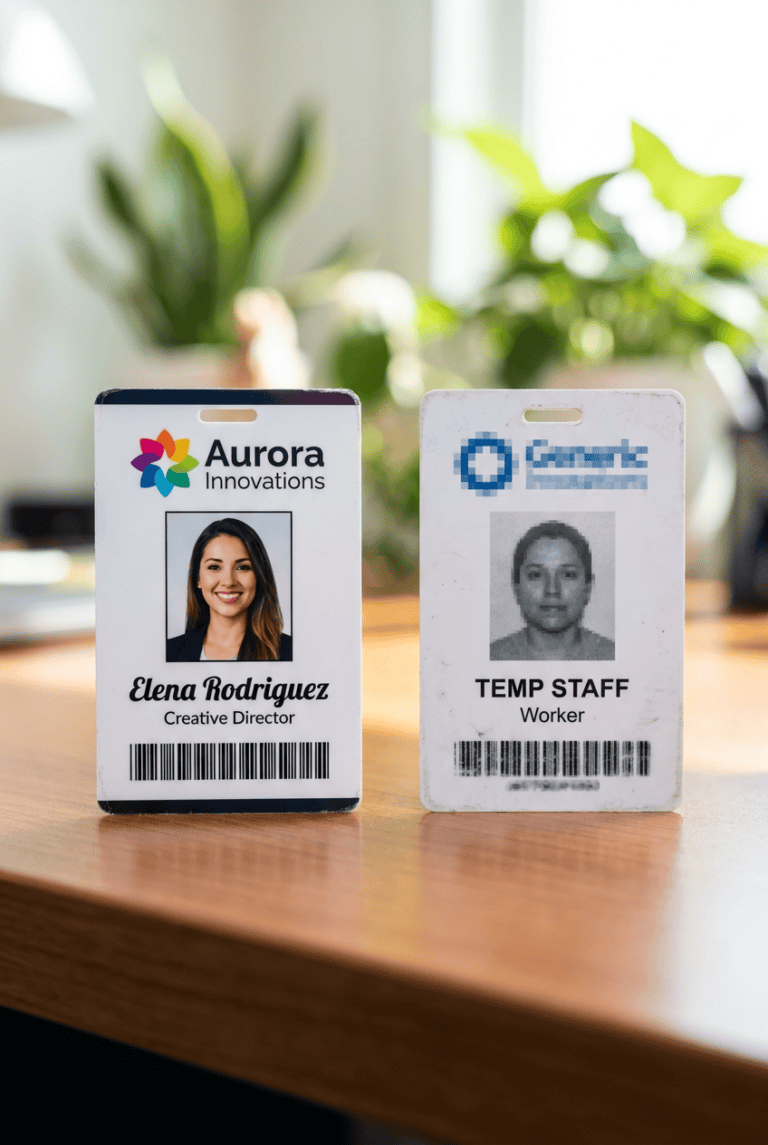
Generic cards often have minimal info: a name, maybe a logo. That’s easy to copy and easy to ignore.
Custom badges can include:
- Photo ID with consistent placement and sizing
- Role indicators (staff, contractor, visitor, student, security)
- Visual security elements (colour bands, patterns, microtext-style design)
- Unique IDs tied to a system (HRIS, access control, attendance, etc.)
2) Scannability (QR, Barcode, or Both)
If scanning is part of your workflow, design matters. QR codes and barcodes need:
- Enough contrast
- Quiet zone (spacing)
- Proper sizing for the scanners you use
- Placement that avoids glare or wear
3) Durability and Replacement Rate
Generic “cheap” cards are often expensive in disguise:
- Cracked corners
- Print rubbing off
- Faded photos
- Reprints and admin time
Custom production options can improve longevity (lamination/overlay, more durable substrates, better print methods). If your badges live in tough environments—healthcare, manufacturing, job sites, warehouses—durability isn’t a luxury. It’s math.
4) Brand Consistency and Professionalism
A badge is one of the few brand touchpoints your staff literally wear. A cohesive design:
- Signals credibility to clients/patients/visitors
- Reduces the “who’s who” confusion
- Makes security enforcement easier (all staff badges look like this”)
5) Workflow Fit (Contractors, Visitors, Events, Shifts)
Custom systems shine when you need variations:
- Visitor badges with expiry dates
- contractor badges with different colour bands
- Students vs staff vs volunteers
- Shift-based identifiers
- Department-based access indicators
A generic card is one template. A real organization is not.
6) Privacy Considerations in Canada
If badge data includes personal info, be intentional. Under Canadian privacy expectations (including PIPEDA principles), minimize what’s displayed and avoid sensitive data on the face of a badge. Government guidance is a good baseline for privacy-by-design thinking.
Where Custom Badges Pay off Fastest
Custom ID badges are especially valuable in:
- Healthcare: fast role verification, reduced errors, clearer identity
- Security: visitor management, guard verification, access enforcement
- Warehousing/Logistics: scan-based workflows, durable gear
- Manufacturing: restricted areas, safety compliance, contractor control
- Trades: job site verification, contractor tracking
A Quick “Should We Upgrade?” Checklist
If you answer “yes” to any of these, generic cards are likely holding you back:
- Do we scan badges today (or want to)?
- Do we reprint badges often due to wear?
- Do we have contractors/visitors frequently?
- Do we need quick role identification (nurse, security, staff, student)?
- Do we need better access enforcement?
- Do we want a consistent professional look across locations?
Next Steps
If you want a badge system that works in the real world, start with:
- Your use case (verification, scanning, access control, events)
- Your environment (office vs industrial vs healthcare)
- The right scannable format (QR, barcode, or both)
- A design that is brand-consistent and scanner-friendly
Contact us to request a sample layout, and we can suggest a scannable badge format for your workflow.
Table of Contents
Centralized vs. Decentralized Badge Printing for Healthcare
Centralized vs. Decentralized Badge Printing in Healthcare? Let Someone Else Handle It. Let’s be real for a second. If you’re managing a hospital department, a
5 Must-Have Features for Trades ID Badges
5 Must-Have Features for Trades ID Badges That Actually Work on Site Forget flimsy paper badges or faded clips. On a busy job site, your
Centralized vs. Decentralized Badge Printing
Centralized vs. Decentralized Badge Printing: Which One Actually Fits Your Team? Let’s be honest: the last thing you want is an ID badge system that