
What’s Your Biggest ID Badge Headache?
Common Problems and Fixes for Canadian Teams
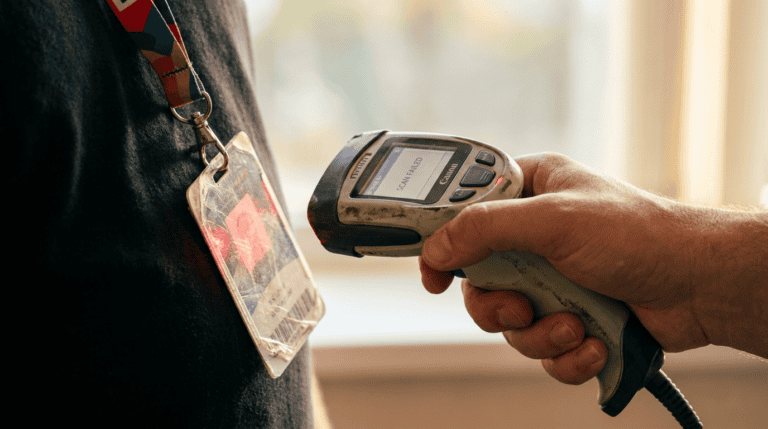
Every organization with ID badges eventually has badge problems.
Some are small annoyances. Some become expensive. Some make people say things like, “Can we just stop using badges?” which is rarely the ideal security strategy.
The good news is that most ID badge problems are fixable. Fading print, cracked cards, scanning failures, constant reprints, unclear roles, and worn-out QR codes usually stem from design choices, material selection, finishing, or workflow planning.
Let’s look at the most common ID badge headaches—and what usually fixes them.
Problem 1: The Badge Fades Too Quickly
Fading is one of the most common badge complaints.
It may show up as:
- Photos are becoming washed out
- Text becoming hard to read
- Logos losing clarity
- Barcodes or QR codes are becoming unreliable
- Cards looking old long before they should
Common Causes
Fading can occur due to daily friction, sunlight, cleaning products, low-quality printing, or a lack of a protective overlay.
Badges used in healthcare, manufacturing, warehousing, trades, and outdoor environments are more likely to experience wear.
The Fix
Consider:
- Protective overlays or lamination
- More durable materials
- Better badge holders
- Adjusted placement of high-wear elements
- Testing samples before a full production run
Do not place important scanning codes in areas that rub against clips, reels, desks, tools, or card holders.
Problem 2: QR Codes or Barcodes Don’t Scan Reliably
Few things are more frustrating than a badge that scans only when held at the perfect angle under perfect lighting, while everyone in line silently judges the process.
Scanning failures are usually design-related.
Common Causes
- Code printed too small
- Low contrast
- Busy background behind code
- Code too close to card edge
- Poor print resolution
- Scratches over the code
- Wrong code type for the scanner
- Glare from finish or holder
The Fix
Use proper sizing, contrast, and a quiet zone around the code. Test the badge with the actual devices you will use.
For phone scanning, QR codes are often convenient. For warehouse or library scanners, barcodes may be faster. Some organizations use both to support different workflows.
GS1 Canada is a useful reference point for understanding barcode standards and structured identification systems.
Problem 3: Cards Crack or Break
Common Causes
- Thin card stock
- Heavy daily use
- Badges clipped through punched holes
- Rough environments
- Frequent bending
- Poor storage or accessories
The Fix
This is especially important for trades, warehouses, manufacturing, and industrial workplaces where badges are subject to physical wear.
Problem 4: You’re Constantly Reprinting Badges
Reprints are more expensive than they seem.
The card itself is only part of the cost. You also lose admin time, design time, approval time, shipping time, and sometimes staff productivity.
Common Causes
- Badges are wearing out too quickly
- Employees changing roles frequently
- No standardized template
- Mistakes in variable data
- Poor onboarding/offboarding process
- No clear replacement policy
The Fix
Create standardized badge templates by role or department. Use variable data printing for names, photos, employee IDs, QR codes, and barcodes. Keep the design flexible enough to handle role changes without having to rebuild from scratch.
A good badge system should scale.
Problem 5: Nobody Can Tell Who’s Who
A badge may have a name and photo, but if staff, visitors, contractors, volunteers, students, and security all look similar, the badge is not doing enough.
Common Causes
- Similar layouts across all badge types
- Tiny role labels
- No colour coding
- No expiry dates for temporary badges
- No access level indicators
The Fix
Design different badge categories with a clear visual hierarchy.
Use large labels like:
- STAFF
- VISITOR
- CONTRACTOR
- STUDENT
- SECURITY
- VOLUNTEER
Colour bands can help, but always pair colour with readable text.
Problem 6: The Badge Has Too Much Information
More information does not always mean better security.
In fact, a cluttered badge can be harder to read and may expose unnecessary personal data.
Common Causes
- Trying to fit every detail on the card
- Printing internal notes or IDs unnecessarily
- Adding too many icons or labels
- No clear priority order
The Fix
Decide what must be visible and what can live behind a secure QR code or barcode lookup.
For example, a badge may show name, photo, role, and department, while the QR code connects authorized staff to more detailed information in a secure system.
Problem 7: Badge Accessories Are an Afterthought
The badge itself may be fine, but the way it is worn can cause problems.
Common Causes
- Cheap lanyards breaking
- Clips damaging cards
- Reels pulling on punched slots
- Holders scratching surfaces
- Badges flipping backward
The Fix
Choose accessories based on the environment.
Office staff may be fine with lanyards. Healthcare staff may need wipeable badge reels or role tags. Industrial teams may need stronger clips or holders. Warehouse teams may need badge placement that supports fast scanning.
Accessories are not just decoration. They affect usability and badge lifespan.
A Quick Badge Audit Checklist
- Do our badges scan reliably?
- Are QR codes and barcodes large enough?
- Are roles visible at a glance?
- Do temporary badges have expiry dates?
- Are badges wearing out too quickly?
- Are reprints becoming a recurring admin task?
- Is sensitive information displayed unnecessarily?
- Are badge materials suitable for the workplace?
- Are accessories helping or hurting durability?
If the answer to several of these is “no,” the badge system probably needs a redesign.
Final Thoughts
Most badge problems are not random. They are symptoms of mismatched materials, weak design, poor code placement, or workflows that have outgrown the original badge setup.
The good news is that small improvements can make a big difference.
A badge may be small, but it carries a lot of responsibility.
If your ID badges are fading, cracking, failing to scan, or causing constant reprints, it may be time for a design and durability review.
At abc identity SOLUTIONS, we use retransfer technology to ensure that your cards look their best, scan properly each time, and remain secure. We also use the right card stock tailored to your industry and environment to ensure your badges last.
Contact us at 204-813-5400 or email us at info@abcidentity.ca for a quote or to discuss your ID badge needs.
If you need inspiration, please visit our store.
Table of Contents
Centralized vs. Decentralized Badge Printing for Healthcare
Centralized vs. Decentralized Badge Printing in Healthcare? Let Someone Else Handle It. Let’s be real for a second. If you’re managing a hospital department, a
5 Must-Have Features for Trades ID Badges
5 Must-Have Features for Trades ID Badges That Actually Work on Site Forget flimsy paper badges or faded clips. On a busy job site, your
Centralized vs. Decentralized Badge Printing
Centralized vs. Decentralized Badge Printing: Which One Actually Fits Your Team? Let’s be honest: the last thing you want is an ID badge system that
QR Code Badges: Your Pocket Digital Workstation
Stop Your ID Badge from Being Lazy: Turn It Into a Digital Workstation Let’s be real. Your employee badge has one job: get you through
Unified Healthcare IDs: A Compliance Framework
How to Manage Badge Compliance for Staff, Residents, and Visitors Without the Headache If you manage badges in a healthcare or LTC setting, you know
PVC vs. Polyester vs. Generic Plastic ID Badges
PVC vs Polyester vs. Cheap Plastic: A No-Nonsense Guide to Badges That Won’t Quit on You Let’s be real: your average employee ID badge has
How ID Badge Design Improves Security & Efficiency
The Vertical Shift: How Modern ID Badge Design Improves Security & Efficiency In any facility, from a corporate office to a warehouse floor, the employee
What Goes Wrong with Cheap ID Badges?
What Goes Wrong with Cheap ID Badges? The Hidden Costs of Low-Quality Badge Design Cheap ID badges can look like a great deal at first.