
What Makes a Retransfer-Printed Badge Nearly Impossible to Forge?
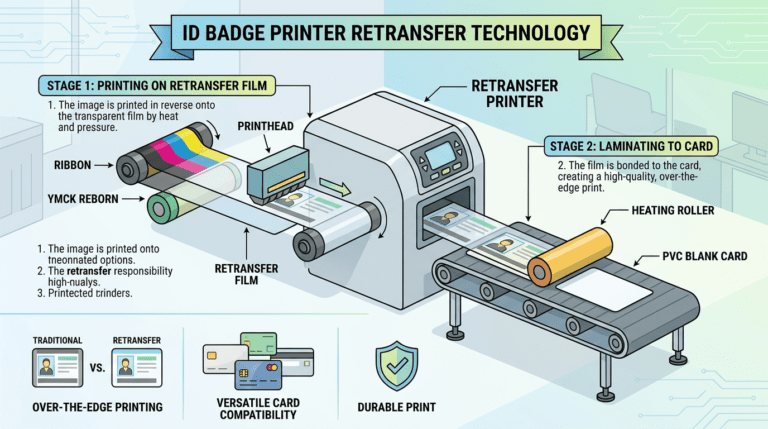
Regarding physical identity credentials, not all ID cards are created equal. A badge printed on a standard direct-to-card printer looks professional and functions fine for low-stakes environments. However, for organizations where security is critical, such as government buildings, healthcare facilities, corporate campuses, and data centers, a higher standard is required. That’s where retransfer printing comes in.
Retransfer-printed badges are widely regarded as some of the most secure physical credentials available. Here’s a deep dive into what makes them so difficult to forge — and why that matters for your organization.
What Is Retransfer Printing?
To understand why retransfer badges are secure, you first need to understand how they’re made.
Standard direct-to-card (DTC) printers apply ink or dye directly onto the surface of a PVC card. The result is a functional card, but the print sits on top of the card surface, making it more vulnerable to tampering, wear, and duplication.
Retransfer printing works differently. The printer first prints the image — in reverse — onto a clear retransfer film. That film is then thermally fused onto the card surface under heat and pressure. The result is a print that is embedded beneath a protective overlay rather than sitting on top of the card.
This seemingly small difference in process creates a cascade of security advantages.
1. Over-the-Edge, Edge-to-Edge Coverage
One of the most visible differences between retransfer and direct-to-card printing is coverage. DTC printers leave a small unprinted border around the card edge due to mechanical limitations. Retransfer printers cover the entire card surface, including the edges.
This matters for security because:
- Edge-to-edge printing is a visual indicator of a high-security credential. Forgers attempting to replicate the card on cheaper equipment will almost always leave that telltale white border.
- Any attempt to trim or alter the card edges becomes immediately obvious.
- The seamless surface enables faster, more reliable visual inspections for security personnel.
2. The Retransfer Film Acts as a Built-In Laminate
The clear retransfer film that carries the printed image also doubles as a protective overlay once it’s fused to the card. This is significant for two reasons:
- Durability: The image is sealed beneath a hard, transparent layer, protecting it from scratches, UV fading, and everyday wear far better than a surface-printed card.
- Tamper Evidence: To alter anything on the card — a name, photo, or access code — a forger would need to physically remove this fused film. Doing so destroys the card surface, making tampering immediately visible. There is no clean way to peel, re-press, or chemically dissolve the film without leaving permanent evidence of interference.
3. Support for Advanced Security Features
Retransfer printers are engineered to incorporate multiple layers of anti-counterfeiting technology into a single card. These features work together to create a credential that is extremely difficult to replicate, even with access to high-quality printing equipment.
- UV Fluorescent Printing: Hidden images or text printed in UV-reactive ink are invisible under normal light but appear clearly under an ultraviolet lamp. This is a widely used overt-to-covert verification method for security personnel.
- Micro-Text: Extremely small text — often too small to read with the naked eye — is embedded in backgrounds or borders. Under magnification, it reads clearly; when photocopied or scanned and reprinted, it turns into an unreadable blur.
- Guilloche Patterns: Intricate, mathematically generated line patterns (like those found on currency) that are nearly impossible to reproduce accurately with consumer-grade scanners or printers. Any copy will show distortion or moiré effects.
- QR Codes and Barcodes: These offer another layer of security and can be combined with your existing security access system. Since our printers use 600 dpi print technology, your images come out clear. If someone forges one of your badges, the image won’t be as clear and can render the card unreadable.
4. Print Quality That's Difficult to Match
Retransfer printers produce images at resolutions of 600 dpi with significantly richer colour depth and sharper detail than most direct-to-card systems. Photographs are more lifelike, text is crisper, and fine-detail artwork is more precise.
This high fidelity is itself a security feature. A forged card reproduced with a lower-quality printer will show visible differences in photo quality, colour saturation, and fine-line sharpness. These are differences that trained security personnel can detect at a glance.
Many organizations intentionally print complex photographic backgrounds or detailed artwork on their credentials precisely because these elements are difficult to reproduce accurately.
5. Centralized, Controlled Issuance
Physical security features are only part of the equation. Retransfer printing systems are typically deployed as part of centralized, controlled credentialing programs, which means card issuance is restricted, logged, and audited.
- Blank retransfer cards and films are controlled consumables and are not widely available at retail.
- Issuance is tied to verified identity records in an HR or access control database.
- Lost or stolen cards are deactivated in the system, making a forged copy of a deactivated credential useless at an electronic reader.
This process control means that even if someone overcame all the physical security features, they would still need to defeat the digital infrastructure behind the credential.
Who should be using retransfer-printed badges?
Retransfer printing is the right choice for organizations where the consequences of a forged credential are significant:
• Government agencies and contractors with compliance requirements
• Healthcare organizations managing access to restricted areas and patient data
• Corporate campuses with sensitive R&D, financial, or executive areas
• Data centers and critical infrastructure facilities
• Universities managing both open campuses and secured research or administrative areas
For trades, security, manufacturing, and warehousing companies, the people on your job sites and shop floors need credentials that hold up, not just on day one, but after months of rough handling, outdoor exposure, and daily wear.
Retransfer printing gives smaller operations access to the same card quality used by large enterprises: edge-to-edge colour, sharper photos for quick visual ID, and a fused protective layer that resists scratches, chemicals, and UV fading. That durability means fewer reprints and lower long-term costs.
It also raises the bar against credential fraud. In industries where site access controls, liability, safety compliance, and theft prevention are a concern, a badge that’s genuinely hard to copy isn’t a luxury — it’s a practical safeguard.
Retransfer Cards Are More Than a Photo
Retransfer technology combines manufacturing complexity, embedded anti-counterfeiting features, high-resolution output, smart technology, and controlled issuance into a single credential. Each layer raises the cost, skill, and equipment requirements for a would-be forger, and together, they create a credential that is, for all practical purposes, extremely difficult to replicate successfully.
If your organization relies on physical credentials to control access, verify identity, or maintain compliance, retransfer printing isn’t a premium add-on. It’s the baseline for serious security.
Table of Contents
Centralized vs. Decentralized Badge Printing for Healthcare
Centralized vs. Decentralized Badge Printing in Healthcare? Let Someone Else Handle It. Let’s be real for a second. If you’re managing a hospital department, a
5 Must-Have Features for Trades ID Badges
5 Must-Have Features for Trades ID Badges That Actually Work on Site Forget flimsy paper badges or faded clips. On a busy job site, your
Centralized vs. Decentralized Badge Printing
Centralized vs. Decentralized Badge Printing: Which One Actually Fits Your Team? Let’s be honest: the last thing you want is an ID badge system that
QR Code Badges: Your Pocket Digital Workstation
Stop Your ID Badge from Being Lazy: Turn It Into a Digital Workstation Let’s be real. Your employee badge has one job: get you through
Unified Healthcare IDs: A Compliance Framework
How to Manage Badge Compliance for Staff, Residents, and Visitors Without the Headache If you manage badges in a healthcare or LTC setting, you know
PVC vs. Polyester vs. Generic Plastic ID Badges
PVC vs Polyester vs. Cheap Plastic: A No-Nonsense Guide to Badges That Won’t Quit on You Let’s be real: your average employee ID badge has