
Vertical vs. Horizontal: Why Canadian Security Experts Prefer Portrait Layouts
It seems like a small thing. It is not a small thing. The orientation of your ID badge affects how fast it’s read, how well it scans, how it hangs on a lanyard, and what it quietly says about your organization’s security culture.
What This Means for Your Organization
Somewhere in your building right now, there is a badge hanging sideways on someone’s lanyard. The photo is facing left. The name is unreadable without physically rotating the card 90 degrees. The person wearing it has stopped noticing because they’ve been wearing it for eight months and it’s just part of the furniture now.
This is a small problem that is secretly a medium-sized problem. And it starts at the design stage, long before the badge ever gets clipped to anyone’s collar.
The debate between vertical (portrait) and horizontal (landscape) ID badge layouts comes up constantly in security, healthcare, and facilities management circles across Canada. And while there are legitimate use cases for both, the professionals who think hardest about badge function almost always land in the same place: vertical wins. Here’s why.
"The badge that hangs sideways isn't just an aesthetic problem. It's a security gap. If a guard can't read it at a glance, it isn't doing its job."
The Physics of the Lanyard Problem
Let’s start with the most basic, physical reason: the one that requires no security expertise, no design degree, and no particular industry knowledge to understand.
A lanyard hangs vertically. It attaches at a single point at the top of the badge holder. When you clip a horizontal badge to a vertical lanyard, physics immediately gets involved. The card is wider than it is tall. The attachment point is centred at the top. The card wants to be stable, and the only way a wider-than-tall object achieves stability hanging from a single top-centre point is to rotate 90 degrees until the long edge becomes vertical.
In other words, horizontal badges spin sideways on lanyards. Every time. Without exception, unless you use a special no-twist attachment, which adds cost, adds bulk, and doesn’t always work when someone moves quickly.
A vertical badge, by contrast, is already taller than it is wide. It hangs exactly as intended, face forward, every single time, with no special hardware required. The photo stays facing forward. The name stays readable. The QR code stays oriented correctly for scanning. Everything works as it’s supposed to because the badge orientation matches the physics of how it’s worn.
The Two-Second Rule for Visual Identification
Security professionals and healthcare administrators talk about something called the “two-second glance”: the amount of time a guard, receptionist, or colleague has to visually confirm that someone belongs in a space before they’ve already walked past. Two seconds. Maybe less.
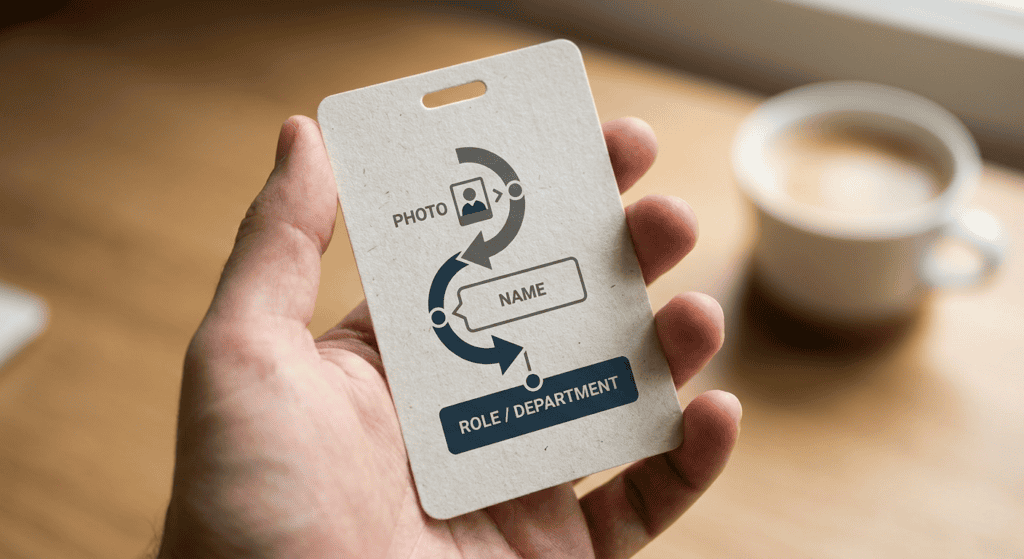
In that window, a well-designed badge needs to communicate three things instantly: who this person is (photo), their name, and their role or authorization level. That’s a significant amount of information to convey in two seconds to someone who is probably also doing five other things simultaneously.
Vertical layouts are built for exactly this kind of rapid information processing. The human eye (particularly in a standing, walking, face-forward context) reads information top to bottom far more naturally than left to right at chest height. A portrait-oriented badge places the photo at the top, the name large in the middle, and the role or department below. The eye travels down the badge in a fraction of a second, taking in everything it needs.
Horizontal layouts require a different kind of reading — wider, more lateral — that works beautifully on a desk, a monitor, or a business card held in someone’s hand. On a badge dangling from a lanyard mid-chest on a moving person? Less so.
"Portrait orientation matches how we read faces and names in real life — top to bottom. The badge that works with that instinct gets verified faster."
QR Codes, Barcodes, and the Scanning Problem
Modern ID badges in Canada increasingly carry machine-readable data: QR codes linking to employee profiles, barcodes triggering access control systems, or contactless chips communicating with readers. Here, orientation matters in a very practical, operational way.
Most barcode and QR code readers (whether wall-mounted, handheld, or integrated into a turnstile) are designed to scan a badge as it’s worn. That means they expect the badge to be facing forward, upright, and at roughly chest height. A vertical badge presented to a reader is already oriented correctly.
A horizontal badge that has rotated 90 degrees on its lanyard requires the wearer to either straighten it manually before each scan or rotate the reader — neither of which is acceptable in a high-traffic security environment where throughput matters.
In a busy hospital, a construction site checkpoint, or a warehouse with dozens of staff clocking in simultaneously, the cumulative delay of everyone stopping to un-rotate their badge before scanning adds up quickly. It also increases the likelihood of frustrated workarounds (propping doors, waving someone through without scanning, or disabling reader requirements entirely) that directly undermine the security infrastructure the badges are supposed to support.
Why do vertical badges scan more reliably?
- The badge hangs face-forward on a lanyard without any manual adjustment
- QR codes and barcodes maintain their correct orientation for reader alignment
- Contactless chip readers are typically positioned for upright card presentation
- Faster throughput at checkpoints — no “hold on, let me straighten this” moments
- Reduced likelihood of workarounds that compromise access control integrity
The Information Hierarchy Argument
There’s a design principle that applies as much to ID badges as it does to magazine covers and app interfaces: the most important information should occupy the most prominent visual position. For a badge worn on a lanyard, that position is unambiguously at the top — the first thing the eye reaches when it looks down at the card.
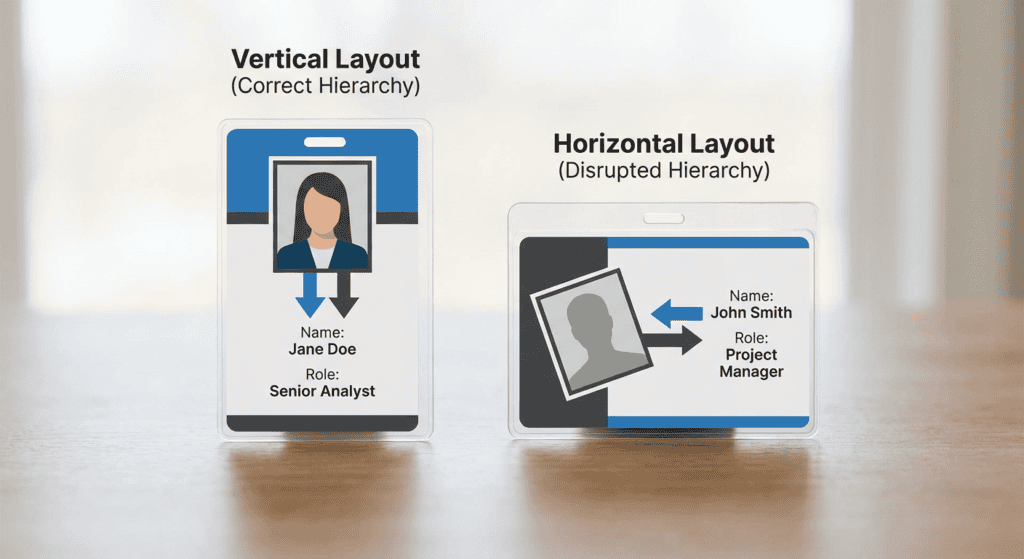
On a vertical badge, the photo occupies the top position. The face. The single most important piece of identification information on the entire card. Below it, at the largest text size, the name. Below that, role and department. Everything flows downward in order of descending importance.
On a horizontal badge, the layout fights the physics. The “top” of the card as designed becomes the left side when the badge rotates on a lanyard. The logo that was supposed to be prominently placed is now on the wrong edge. The hierarchy the designer intended is gone, replaced by whatever the lanyard physics decided to show first.
Vertical badges let the design do what the designer intended. That’s not a trivial advantage when the badge is a security tool.
When Horizontal Actually Makes Sense
Fairness demands acknowledging that horizontal badges aren’t wrong — they’re just wrong for specific contexts. There are situations where landscape orientation is genuinely the better choice.
Legitimate Cases for Horizontal Badges
- Clip-to-Clothing Wear: When a badge is attached via a pin or clip directly to a jacket or shirt pocket, it stays horizontal naturally. No lanyard means no rotation problem.
- Desktop Display: Conference badges, visitor passes, or table credentials that sit flat or are held in a stand benefit from the wider landscape format.
- Wide Logo Designs: Organizations with a strongly horizontal brand mark sometimes choose landscape to avoid compressing or reorienting their logo.
- High-Information Cards: When a badge needs to carry a lot of data — multiple barcodes, detailed contact information, a full address — horizontal may provide more usable layout space.
- Retractable Badge Reels: Unlike lanyards, badge reels attach at the side of the card, which can allow either orientation to hang correctly depending on the reel’s design.
The key question to ask before choosing orientation isn’t “which looks better?” It’s “how will this badge actually be worn, and what does it need to communicate in the first two seconds?” Answer that honestly, and the right choice becomes obvious most of the time.
Head-to-Head: Vertical vs. Horizontal
| Factor | Vertical (Portrait) | Horizontal (Landscape) |
|---|---|---|
| Lanyard stability | Hangs face-forward naturally | Rotates sideways without special hardware |
| Glance readability | Top-to-bottom eye path matches natural reading | Better when held or displayed flat |
| QR/barcode scanning | Correct orientation without adjustment | Requires manual straightening for accurate scan |
| Photo prominence | Photo at top — immediately visible | Photo competes with horizontal layout elements |
| Security checkpoint flow | Faster throughput, no badge-flipping delays | Slows check-in at high-volume points |
| Clip/pin wear | Works fine | Natural orientation when pinned to clothing |
| Wide logo accommodation | Requires logo adaptation | More horizontal space for wide brand marks |
| Industry preference (CA) | Healthcare, trades, security, manufacturing | Corporate, education, events |
What This Means When You're Ordering Badges
Badge orientation is one of those decisions that seems minor at the brief stage and becomes very apparent six months into deployment. The good news is that it costs nothing to get right: it just requires making a deliberate decision rather than defaulting to whatever template the designer happened to open first.
At abc identity SOLUTIONS, we walk every client through orientation choice as part of the design process, not as an afterthought. We ask how the badge will be worn, what it needs to communicate instantly, whether it needs to work with any reader or scanner systems, and what the organization’s existing badge standard looks like.
The answer to those questions (not personal preference, not what looks nice on a monitor) determines the right orientation.
For most Canadian organizations in security-conscious industries, that answer is vertical. And once you’ve worn a badge that actually stays face-forward on a lanyard all day without a single twist, it’s hard to go back.

Need badges that work as hard as your team?
We’ll help you choose the right orientation, layout, and security features for your environment — then print badges that hold up to real Canadian working conditions.
Table of Contents
Vertical vs. Horizontal: Why Canadian Security Experts Prefer Portrait Layouts
Vertical vs. Horizontal: Why Canadian Security Experts Prefer Portrait Layouts It seems like a small thing. It is not a small thing. The orientation of
Why Some ID Badges Last Forever
Why Some ID Badges Last Forever (And Others Fade Before Lunch) The surprisingly fascinating reason why the technology behind your badge matters more than you
The Security Illusion: Why Visual ID is Your First and Last Line of Defense
The Security Illusion: Why Visual ID is Your First and Last Line of Defence The Timbits Paradox: Why Your $50,000 Firewall Can’t Stop a Man
The Badge on Your Guard’s Chest Is a Security Asset — or a Liability
The Badge on Your Guard’s Chest Is a Security Asset or a Liability Every security program has physical badges. Most of them are doing far
QR Codes on ID Badges: 5 Uses Most Companies Haven’t Tried
QR Codes on ID Badges: 5 Uses Most Companies Haven’t Tried Most teams think a QR code on an ID badge is just a fancier
How Do QR Code Badges Work With My Existing System?
How Do QR Code Badges Work With My Existing System? The most common question we hear from security teams, facilities managers, and operations leads is