
Why Some ID Badges Last Forever (And Others Fade Before Lunch)
The surprisingly fascinating reason why the technology behind your badge matters more than you think — and why Canadian businesses are finally getting the durable IDs they deserve.

Picture this: it’s day one at a new job. HR hands you a shiny new ID badge with your photo on it. You look great … maybe a little wide-eyed, but great. You clip it on, walk confidently through those first few doors, and feel like an official, legitimate human being.
Fast forward six months. That badge now looks like it survived a geological era. Your face is a ghostly blur. The company logo has faded to a vague beige smudge. And is that your name? Hard to say. Could be “Dave.”
You’re pretty sure your name isn’t Dave.
This is the tragic lifecycle of a badge printed with outdated technology. Furthermore, it is entirely 100% preventable.
"The badge is often the first thing someone sees when they meet your staff. If it looks like it went through a dishwasher, so does your brand."
The Two Ways to Print an ID Badge (One Is Much Better)
Not all ID badges are created equal. The difference comes down to how the ink — or rather, the colour transfer — ends up on the card. There are two main methods: direct-to-card printing and retransfer printing. One is a bit like writing on a paper bag. The other is more like laminating fine art.
1. Direct-to-Card: The Budget Option With Budget Results
Direct-to-card printing does exactly what the name suggests: the print head presses ribbon dye directly onto the surface of the plastic card. It’s fast, it’s affordable upfront, and for low-stakes situations (a temp lanyard for a one-day conference, say), it gets the job done.
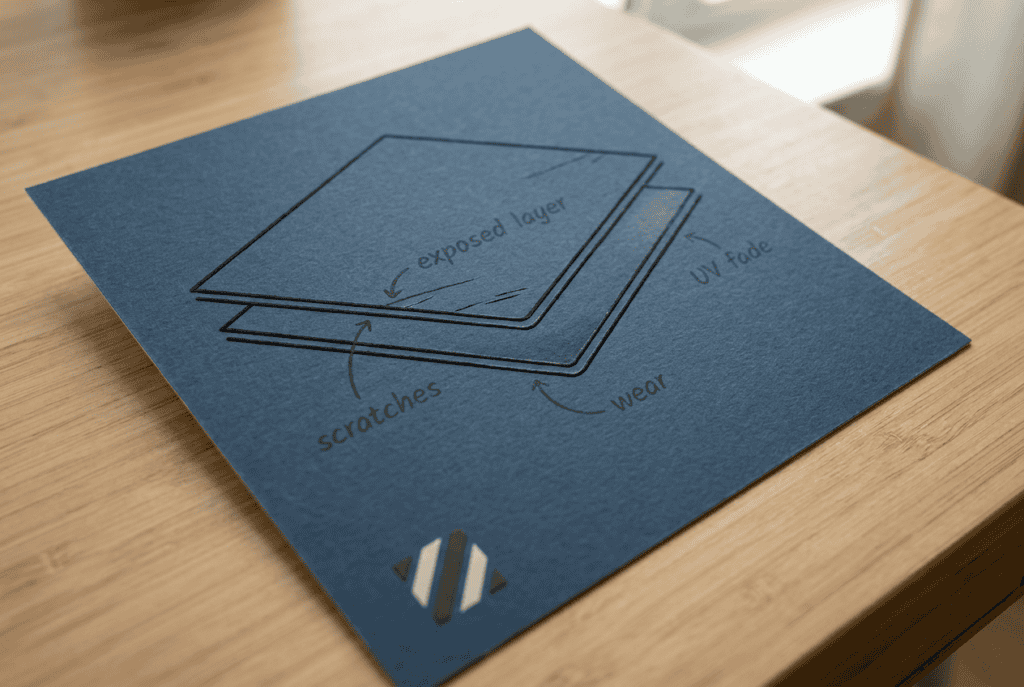
The problem? The image sits right on top of the card surface, completely exposed to the world. Every door handle, every lanyard rub, every accidental brush against a tool belt or stethoscope is essentially an attack on that image. UV light from fluorescent overheads doesn’t help either. Within weeks, the colour starts to dull. Within months, you’re Dave.
2. Retransfer Printing: The Technology That Changes Everything
Retransfer printing works on a completely different principle, and once you understand it, you’ll never look at a flimsy badge the same way again.
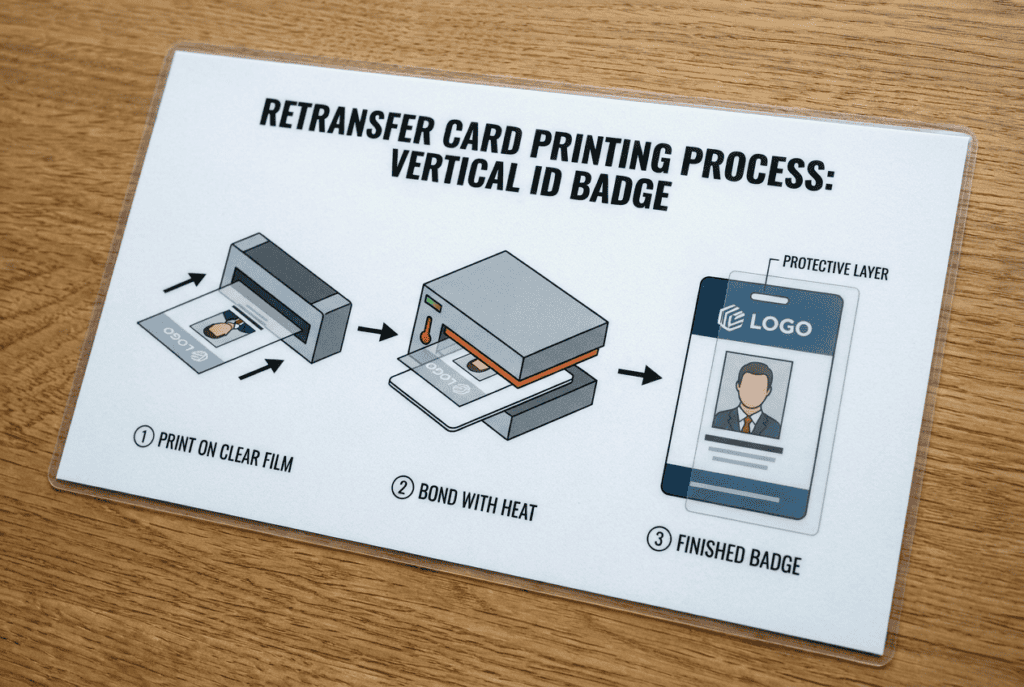
Instead of pressing ink directly onto the card, the printer first creates a perfect, high-definition image on a thin, clear transfer film. Think of it as printing onto a microscopic window. Then, using heat and pressure, that film is bonded to the card’s surface.
Here’s the elegant part: the image ends up sandwiched underneath the protective film layer. The film becomes a shield. Scratches hit the film, not the image. UV light still has to fight through a protective barrier before it can fade anything. The result is a badge that looks stunning from day one and still looks stunning a year later, even on a job site, in a hospital ward, or clipped to the front of a high-visibility vest in a Canadian January.
Once inside, the attacker can access server rooms, executive floors, or any other area the original badge holder was authorized to enter. They can plug devices into network infrastructure, access unlocked terminals, or simply observe and photograph sensitive materials. All of this happens below the radar of a digital zero-trust system.
"The image is sealed under a protective film. Scratches, sweat, and Saskatchewan winters can't touch it."
The Numbers Are Genuinely Impressive
We’re not just talking about badges that look nicer for a few extra weeks. The specifications behind retransfer printing are remarkable for a technology that’s clipping to someone’s collar.
What retransfer technology delivers
- 600 dpi resolution— the print head produces images so sharp you can read microtext with the naked eye (more on that in a moment)
- True edge-to-edge printing— the design covers the entire card surface with zero white border, including over uneven surfaces like smart chips
- Up to 150 cards per hour— high-volume output without sacrificing quality
- 30,000 prints per year capacity— built for organizations that actually need reliable, consistent output
- PETF card core option— a stronger card substrate than standard PVC, ideal for high-use applications or additional lamination
Security Features That Actually Work
Here’s where it gets genuinely interesting. A badge isn’t just a name tag. For many Canadian organizations like healthcare, construction, security, warehousing, and manufacturing, it’s also a security credential. Furthermore, the quality of the print technology directly affects how secure that credential actually is.
Since retransfer printing operates at 600 dpi, it can produce security features that simply aren’t possible on lower-resolution direct-to-card printers:
Closing the physical security gap does not require a separate strategy — it requires applying zero-trust principles consistently across both digital and physical domains. The same logic applies: never trust by default, verify continuously, and limit access to what is necessary.
Microtext
Tiny text printed at a size invisible to the naked eye, visible under magnification. It’s extraordinarily difficult to fake and impossible to photograph clearly enough to reproduce. Useful for healthcare, government, and any organization with strict access control requirements.
Guilloché Patterns
Those intricate, repetitive geometric line patterns you see on currency and official documents — they can be reproduced on an ID badge with the right print resolution. Beautiful and nearly impossible to counterfeit.
High-Definition QR Codes and Barcodes
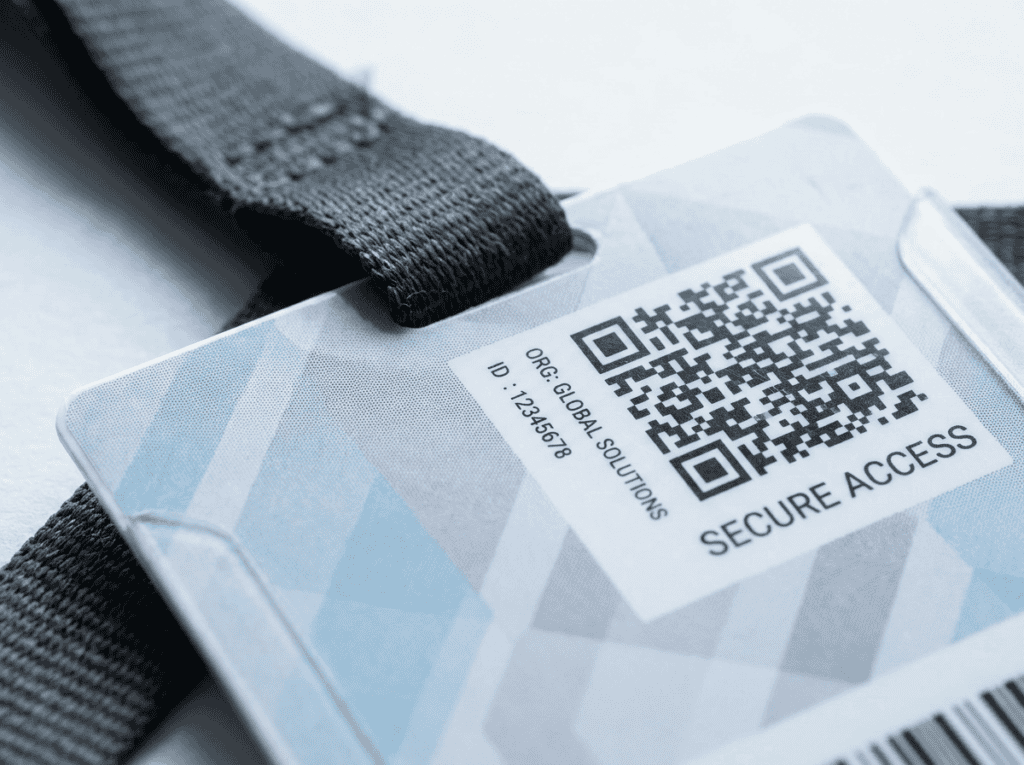
At 600 dpi, QR codes and barcodes are rendered with crisp, scannable precision. This means badges that link to digital profiles, enable contact-free check-ins, trigger vCard downloads, or connect to your organization’s HR systems from a reliable, fast-scanning code that won’t degrade with wear.
Head-to-Head: Retransfer vs. Direct-to-Card
| Feature | Direct-to-Card | Retransfer |
|---|---|---|
| Print resolution | 300 dpi typical | 600 dpi |
| Edge-to-edge printing | No (white border) | Yes, over any surface |
| Image protection | Exposed on surface | Sealed under film |
| Scratch resistance | Low | High |
| UV/fade resistance | Moderate | Excellent |
| Microtext printing | Not possible | Standard capability |
| QR code quality | Adequate | High-definition, reliable scan |
| Smart chip compatibility | Often creates white spots | Prints seamlessly over chips |
| Typical badge lifespan | Months | Years |
Who Needs This in Canada? (Spoiler: A Lot of People)
The industries where durable, high-quality ID badges matter most are also some of Canada’s largest employers. If you work in any of the following, the gap between an adequate badge and an excellent one has real operational consequences:
Industries Where Badge Quality Directly Matters
- Healthcare: Nurses, doctors, and support staff wear badges every shift in environments with chemical exposure, constant physical contact, and strict credential verification requirements.
- Construction & Trades: Job sites are hostile environments for delicate things. A badge needs to survive dust, grease, temperature swings, and the occasional drop into a puddle.
- Security & Access Control: A faded badge that can’t be verified defeats the entire purpose of having one. Badge integrity is access integrity.
- Warehousing & Manufacturing: High-wear environments where badges constantly brush against surfaces. Forklift operators, floor supervisors, logistics staff — they all need badges that last a full employment cycle, not a season.
- Corporate Environments: When clients and visitors see your staff’s badges, it’s a brand moment. A pristine, professional badge says something. So does a faded one.
The Hidden Cost of Cheap Badges
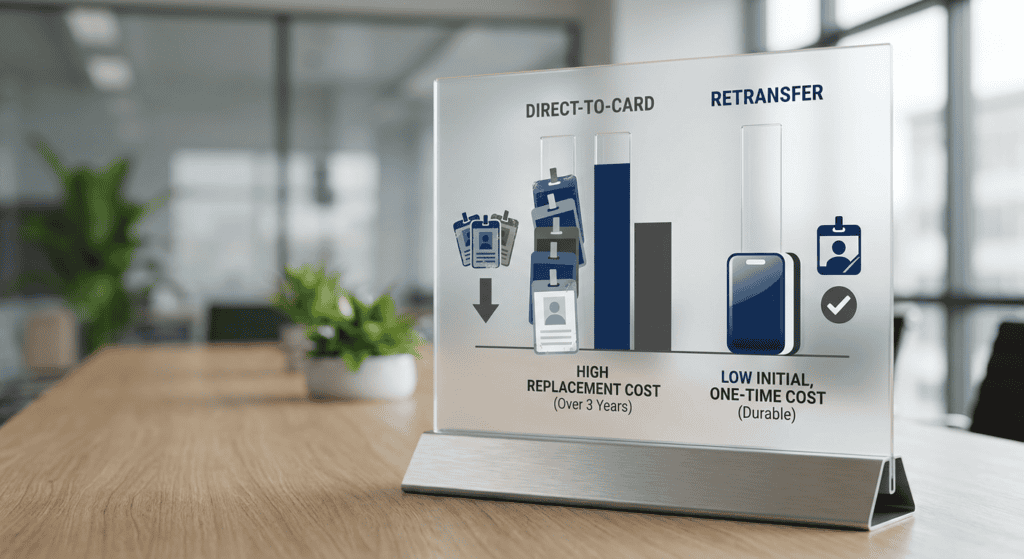
Organizations often choose lower-cost badge printing options to save money, which is completely reasonable. However, the math gets interesting when you factor in replacement frequency.
A direct-to-card badge that needs to be reprinted every six to eight months (factoring in the cost of materials, staff time, and the administrative overhead of managing badge replacements) can easily end up costing more than a retransfer-printed badge that lasts two to three years with no visible degradation. Add in the security risk of worn, unreadable badges slipping through visual verification, and the calculus shifts further.
As the old saying goes, ” Buy nice or buy twice.” (With badges, sometimes buy five or six times.)
What This Means for Your Organization
The bottom line is straightforward. If your people are wearing ID badges every day, particularly in demanding physical environments, the technology behind those badges matters enormously for how long they last, how secure they are, and what they communicate about your organization.
At abc identity SOLUTIONS, every badge we produce is printed using retransfer technology at 600 dpi. That means edge-to-edge coverage, microtext, QR code and barcode capability as standard, and a finished card that holds up to real Canadian working conditions — not just the air-conditioned office variety.
We design badges that look exactly the way your brand deserves on day one and still look that way when the badge is finally retired, not when the printer decides it’s time for a fade.
No proprietary hardware required. No complicated systems. No long-term contracts. Just genuinely excellent badges, designed around your people.
Ready for badges that actually last?
Get a free badge design consultation, and we’ll show you exactly what retransfer printing can do for your organization.
Table of Contents
Vertical vs. Horizontal: Why Canadian Security Experts Prefer Portrait Layouts
Vertical vs. Horizontal: Why Canadian Security Experts Prefer Portrait Layouts It seems like a small thing. It is not a small thing. The orientation of
Why Some ID Badges Last Forever
Why Some ID Badges Last Forever (And Others Fade Before Lunch) The surprisingly fascinating reason why the technology behind your badge matters more than you
The Security Illusion: Why Visual ID is Your First and Last Line of Defense
The Security Illusion: Why Visual ID is Your First and Last Line of Defence The Timbits Paradox: Why Your $50,000 Firewall Can’t Stop a Man
The Badge on Your Guard’s Chest Is a Security Asset — or a Liability
The Badge on Your Guard’s Chest Is a Security Asset or a Liability Every security program has physical badges. Most of them are doing far
QR Codes on ID Badges: 5 Uses Most Companies Haven’t Tried
QR Codes on ID Badges: 5 Uses Most Companies Haven’t Tried Most teams think a QR code on an ID badge is just a fancier
How Do QR Code Badges Work With My Existing System?
How Do QR Code Badges Work With My Existing System? The most common question we hear from security teams, facilities managers, and operations leads is