The ID Badge Paradox: Hidden Truths Behind How Your Employees Really Feel
For decades, the corporate ID badge was a symbol of trust and security — a branding tool, an identification standard, and eventually an access control mechanism. But in an era of rampant cyberattacks and physical security breaches, the way badges are built matters more than ever. Poorly constructed badges don’t just create security gaps. They create friction, erode culture, and quietly undermine the trust your organization depends on. This is the ID badge paradox — and here’s how to solve it.
The Paradox: Your Badge is Both Your Greatest Security Asset and Your Biggest Liability
The corporate ID badge has been the cornerstone of physical security for decades. Yet, for the modern organization, that same badge carries hidden liability. It’s not just a potential security vulnerability — it’s a daily source of friction, frustration, and unintended cultural messaging that quietly degrades employee experience.
The core tension is this: a badge designed to signal trust can just as easily signal the opposite. When an employee struggles with a card that won’t scan, watches their photo fade after three months, or carries something that looks like it was printed on office equipment, the message received is not “we value you.” It’s “we cut corners.”
Solving the paradox requires rethinking what a badge is supposed to do — and investing in credentials that deliver on every dimension: security, professionalism, and employee experience.
The Three Critical Risks of the Traditional ID Badge
Risk 1: Counterfeiting and Cloning - The Security Gap Hiding in Plain Sight.
Standard direct-to-card printing leaves your credentials more vulnerable than most organizations realize. A basic desktop printer and some readily available materials are often enough to produce a convincing counterfeit. Lost cards compound the problem — they’re not just a replacement cost, they’re an open invitation for physical breach or social engineering.
Your access control system is only as strong as its weakest link. For most organizations, that weakest link is the physical badge itself.
Retransfer printing addresses this directly. Rather than printing onto the card surface, the image is first printed onto a clear film that is then thermally bonded to the card. This process enables the embedding of advanced security features — microtext, guilloche patterns, holographic overlaminates — that standard printers simply cannot replicate. The result is a credential that is significantly harder to fake and dramatically more durable than a direct-to-card alternative.
Risk 2: Operational Friction — The Cost that Never Appears on the Invoice
The real cost of a cheap ID badge isn’t in the plastic. It’s in the compounding drain on HR, IT, and your employees every time something goes wrong.
Barcodes and QR codes scratch and peel, making entry systems unreliable. Lamination lifts and renders cards unreadable. Photos and names fade, creating security and brand concerns. Each failure generates a help desk ticket, a reprint request, and a frustrated employee who simply wants to get through the door.
Cheap badges aren’t a one-time purchase — they become a recurring operational expense. And the hidden cost is the message they send: that your organization isn’t willing to invest in tools that work reliably.
High-quality retransfer-printed badges eliminate the majority of these failure points. The protective film layer resists scratching, abrasion, UV exposure, and moisture — dramatically extending card life and reducing replacement frequency.
Risk 3: The Trust Deficit — What a Bad Badge Says About Your Culture
Every touchpoint in an employee’s day reflects your organization’s values. The ID badge is one of the most frequently handled pieces of company property — and a generic, low-quality, or unreliable one sends a message whether you intend it to or not.
There’s also a subtler dynamic at play. When an employee has to swipe three times to get through a door, fumble with a card that won’t read, or wear something that looks worn out after a month, the badge stops feeling like an asset and starts feeling like surveillance equipment that doesn’t even work properly. That’s the “Big Brother” problem — not just being watched, but being watched by a system that doesn’t respect your time.
Conversely, a crisp, professional, seamlessly functional badge sends a different message entirely: we invest in quality, we trust you, and we take your experience seriously. That distinction matters more than most organizations give it credit for.
Solving the Paradox: The abc identity SOLUTIONS Difference
- Print Technology: Retransfer (reverse transfer)
- Resolution: 600 DPI — both sides
- Print Coverage: Full edge-to-edge
- Card Compatibility: PVC, composite PVC, polycarbonate
- Lamination: Optional
- Memory Security: Automatic erase after each job
- Encoding Support: Barcode, or QR code,
- Production: High-volume, network-ready
Edge-to-Edge Coverage and a Professional Finish
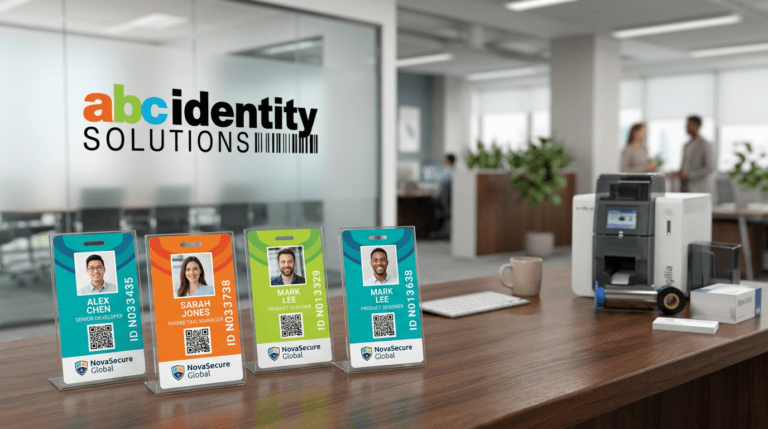
Since we print onto an oversized retransfer film before bonding it to the card, the design covers the entire card surface — right to the edges. This eliminates the white border that’s the telltale sign of direct-to-card printing, produces a cleaner and more premium result, and makes the card significantly harder to tamper with at the margins.
600 DPI on Both Sides — Accurate Colours, Sharp Photos, Legible Detail
We deliver 600 DPI resolution across both sides of a dual-sided print job — not just the front. Employee photos are crisp and colour-accurate, logos render exactly as designed, and fine security details like microtext and guilloche patterns are fully legible. This is the standard that direct-to-card printers consistently fall short of, particularly on reverse sides where quality often degrades.
Compatible with Advanced Card Materials
We can handle PVC, composite PVC, and polycarbonate card stock with equal print quality — something direct-to-card printers cannot reliably do. This matters for organizations that need polycarbonate’s enhanced durability and tamper-resistance, or composite PVC’s superior resistance to warping under daily use.
Built-In Tamper Evidence
Any attempt to peel or alter the retransfer film destroys both the film and the card surface beneath it — leaving an immediately visible indicator of tampering. There’s no clean way to modify a retransfer-printed badge without making the fraud obvious.
Anti-Counterfeiting Features Built Into Every Badge
Microtext
Extremely small text embedded into the badge design — typically invisible to the naked eye but verifiable under magnification. Our 600 DPI resolution enables sharp, consistent output. It requires precision equipment to replicate, making it a strong deterrent against counterfeiting.
Guilloche Patterns
Intricate, repeating fine-line patterns — the same technique used on banknotes and official government documents — rendered with precision at 600 DPI. Nearly impossible to reproduce accurately without the same class of equipment.
High-Definition QR Code and Barcode Printing
QR codes and barcodes printed at 600 DPI are sharper, more reliably scannable, and significantly more durable than those produced by standard printers. Protected by the retransfer film layer, they resist the peeling and scratching that makes low-quality badge barcodes one of the leading causes of access control failures.
What sets abc identity SOLUTIONS apart?
Printer Memory Erase — Data Security at the Hardware Level
Our printers automatically erase sensitive data from their internal memory after each print job. This is a built-in security feature of our platform — not an add-on or a manual process — which means your employee images and personal data are never retained on the device between print runs. For organizations handling sensitive personnel information, this is a meaningful and verifiable data protection measure.
Secure Data Handling From Upload to Delivery
Beyond the printer itself, your employee data and images are handled through a fully secure, compliant process at every stage — from the moment you upload files to the moment your badges are delivered. We take data handling seriously because our clients’ trust depends on it.
Scalable Production for any Volume
We only use a high-volume, network-ready printer — meaning we can scale quickly, whether you’re onboarding a team of ten or issuing credentials across multiple locations simultaneously. Dual-sided printing is standard, making it easy to include compliance information, QR codes, emergency contacts, or access instructions on the reverse side of every card.
One Card. Every Function.
We design credentials that consolidate everything your employees need into a single, highly secure card — photo ID, barcode or QR code access, and professional brand representation. Fewer cards, less friction, and a cleaner experience for everyone.