Printed vs Digital ID Badges: Which Is Right for Your Business — and How a Hybrid System Can Give You Both
Many businesses are weighing the advantages and trade-offs of printed ID badges, digital ID solutions, and hybrid systems — trying to determine which approach best fits their security needs, budget, and operational reality. While digital credentials offer modern convenience, printed ID badges remain a reliable, cost-effective, and highly secure choice for most organizations. Here’s an honest look at both — and why the hybrid approach is increasingly where smart businesses land.
The Advantages of Printed ID Badges
1. Tangible, Always-On Identification
Printed badges are physical items employees wear or carry at all times — no device, app, or battery required. This makes them immediately visible to security personnel, visitors, and colleagues without any additional equipment or steps. Quick visual verification is one of the most underrated advantages of a physical credential, particularly in environments where speed of identification matters.
2. Enhanced Security Features
Modern printed ID badges can incorporate a robust range of security elements — barcodes, QR codes, microtext, guilloche patterns, and UV-printed hidden features. These make unauthorized duplication significantly more difficult and give organizations layered protection that goes well beyond a simple photo card.
Combined with employee photos and company logos, a well-produced printed badge is a critical component of workplace security and access control.
3. Cost-Effective and Straightforward to Manage
Printed ID badges are generally more affordable to implement than digital systems — particularly for small and medium-sized businesses — with no reliance on third-party platforms, app subscriptions, or ongoing licensing fees. When an update is needed, it typically requires reprinting the card rather than navigating a software system.
4. Professional Appearance and Consistent Branding
A well-designed printed badge is a daily brand touchpoint. Organizations can incorporate brand colours, logos, and contemporary design into a physical credential that employees wear as part of their working identity. Unlike digital badges — which exist primarily on a screen — printed badges provide constant visual reinforcement of company identity, particularly in public-facing industries.
The Limitations of Digital ID Badges
1. Technology Dependency
Digital ID badges rely on smartphones, apps, or digital devices to function. If a device is lost, stolen, or runs out of battery, access can be immediately disrupted — and security personnel may have no way to verify identity without the app working correctly. This dependency introduces a single point of failure that printed badges simply don’t have.
2. Cybersecurity Exposure
Poorly implemented digital ID systems can be vulnerable to hacking, phishing, and unauthorized access — risks that printed badges don’t carry in the same way. While well-built digital systems have strong security measures, their attack surface is inherently broader than that of a physical credential. Organizations handling sensitive personnel data should carefully evaluate this trade-off.
3. Limited Physical Presence
Digital badges cannot be worn, seen at a glance, or instantly verified the way a printed badge can. In visitor management, onsite events, or multi-tenant buildings, physical visibility matters — and digital credentials simply cannot replicate the immediate recognition that a worn badge provides.
Printed vs Digital vs Hybrid: Side-By-Side Comparison
| Feature | Printed | Digital | Hybrid |
|---|---|---|---|
| Visibility | Always visible | Device required | Physical + digital |
| Security | Hard to duplicate | Broader attack surface | Layered protection |
| Cost | Affordable, low overhead | Subscription-based | Moderate, scalable |
| Branding | Excellent | Primarily screen-based | Physical branding maintained |
| Remote access | Not supported | Mobile and remote | Both supported |
| Durability | Long-lasting | Device-dependent | Physical badge + digital backup |
| Tech dependency | None | High | Low — physical card primary |
The Hybrid ID Badge System: The Best of Both Worlds
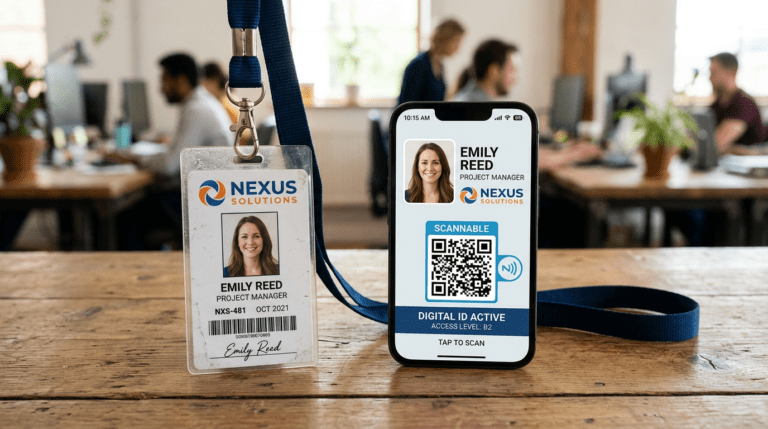
For most organizations, the answer isn’t a binary choice between printed and digital. A hybrid system — physical printed badges for daily identification and access, integrated with digital credentials for remote verification, mobile access, or advanced tracking — delivers the advantages of both without the core limitations of either.
Flexibility Without Compromise
Employees carry a physical badge for day-to-day access and face-to-face identification, while digital credentials handle mobile access, company app authentication, or secure remote portal entry. Both work independently — so if one fails, the other covers it.
Strengthened Security Through Layering
Physical badges are difficult to duplicate. Digital credentials can track real-time activity and generate audit trails. Together, they create a security posture that is meaningfully stronger than either approach alone. If a printed badge is lost, digital credentials can deactivate access remotely — instantly, without waiting for a replacement card to be issued.
Scalable From Day One
Organizations can start with printed badges and layer in digital functionality as they grow or as needs evolve. This approach keeps upfront costs low while building a system that scales without requiring a complete overhaul as the business changes.
Branding that Travels With Your Employees
Even in a hybrid system, the printed badge maintains its role as the visible, daily brand touchpoint. Digital credentials handle the advanced functions invisibly, while the physical badge continues to project professionalism and company identity — in the office, at client sites, and everywhere in between.
Which system is right for your organization?
- Printed badges only work well for smaller organizations, public-facing roles, and environments where instant visual verification is the primary requirement
- Digital badges only suit remote-first or fully mobile workforces where physical presence and visibility are less critical
- Hybrid systems are the strongest choice for most mid-sized to large organizations, particularly those managing hybrid workforces, rotating contractors, multi-site access, or compliance-heavy environments
The good news: you don’t have to choose between security and convenience. The right credential strategy delivers both.